
Some years, Valentine’s Day feels easy, sweet, uncomplicated.
This year, for a lot of people, it doesn’t.
When the world feels hot with anger, louder by the day, and so full of “look at me” noise that even love can feel a little… hollow, it’s fair to ask the question:
What actually makes the world better, safer, kinder, especially for our children?
And when Bad Bunny, who wraps his whole identity in a rabbit—soft on the outside and fierce underneath, like a wake-up call—says “love is the answer,” the honest reply is: maybe, but only if love stops being a slogan and starts being a practice.
So, here’s my personal point of view, from the vantage point of a nature center administrator, a father, and a person who has watched thousands of people change their mood in under thirty seconds simply by seeing a bluebird, a bald eagle or, hearing a chickadee.
Lovebirds were not invented by card companies.
First, a small but important reset.
“Lovebirds” are not a marketing invention. The word “lovebird” has been around for centuries, with early recorded English use dating to the late 1500s.
Humans didn’t invent lovebirds. We noticed them.
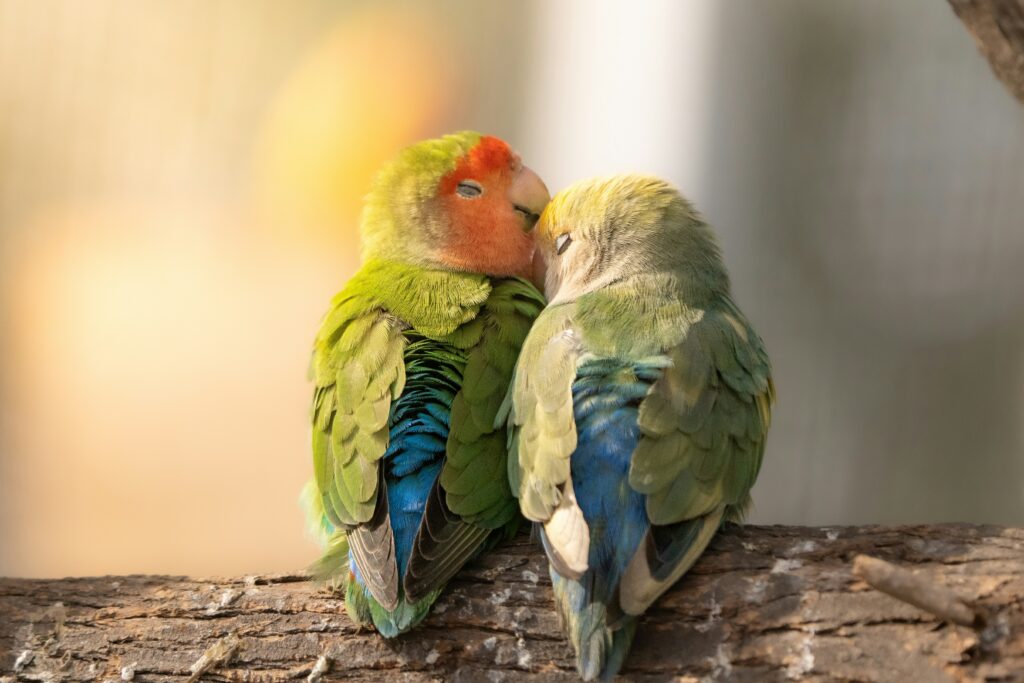
And the reason people noticed them is simple: these small parrots are famous for close pair bonding—spending long stretches perched together, doing life side by side.
So, before love got packaged and sold, it was observed in the natural world as attention, loyalty, proximity, and patience.
That’s a better starting place.
Why Doves Became a Symbol of Love & Peace
Doves did not become symbols because they were trendy. They became symbols because they were useful to the human heart.
In ancient mythology, doves were associated with Aphrodite, the goddess of love, which helped shape the “doves = romance” connection over time.
And the “peace dove” became especially recognized worldwide in the modern era, helped along by Picasso’s famous dove image, “La Colombe,” used in connection with the Paris World Peace Congress in 1949.
So yes, doves truly are a symbol of love and peace, and that symbolism has deep roots.
Four Dinner-Table Lovebird Facts (the Fun Kind)
If you want to be the most interesting person at the Valentine’s Day table without trying too hard, here are four quick facts you can drop between the breadbasket and dessert.
1. “Lovebird” is an old word.

Merriam-Webster traces first known use to 1597, in John Lyly’s play, “The Woman in the Moone,” which referred to the actual birds themselves, while the figurative use of the term became more popular in the 19th century.
2. Lovebirds are native to Africa, with one species from Madagascar.
So their story begins in real habitats, not in greeting-card aisles.
3. Their scientific name literally means “lovebird.”
It’s built from Ancient Greek roots meaning love (agape) and bird (ornis). (You don’t need to say the name out loud at dinner; just enjoy the meaning.)
4. They are tied to the world-famous peace dove moment that began in 1949.
Picasso’s dove image became a major peace emblem through that era’s peace movement events.
The Real Question: What changes WNY & the world?
Here’s what I believe, without fluff:
The world gets better when people relearn attention.
History has taught us that when societies lose their center, we get distracted by spectacle, addicted to outrage, and pulled toward simplifications that make us meaner. We stop seeing people clearly, we stop seeing consequences clearly, and we start calling that blindness “normal.”
Nature teaches the opposite.
Nature says: everything is connected. Nothing is free. Damage echoes.
Birds are especially good at delivering this lesson because they are both delicate and fierce. They rely on habitat, clean water, food webs, and safe corridors. When those systems break down, birds tell the truth early, often before we want to hear it.
Not with speeches. With absence.
So, what have we lost focus on?
We’ve lost focus on the fact that we belong to something, and that belonging carries responsibility.
A Bigger Valentine’s Message: Love as Repair
This is where I want to say something bigger than our nature center.
I believe the natural world is still trying to reach us.

Not to scold us, but to re-awaken us.
Nature has a way of finding people who are willing to listen. And when we do listen, we start to notice what the living world is feeling, and suffering from, and signaling to us.
Then comes the hard part, and the hopeful part: We can choose repair.
Not in one grand gesture, but in a thousand small ones.
Love, in its most mature form, is not a mood. It is not a performance. It is not a caption.
Love is what you do when something vulnerable is in your care.
That is parenting. That is community. That is conservation.
And if we can turn our love outward, toward the places that give us life—water, trees, birds, wetlands, sky—we do something remarkable: we become the kind of adults our kids can trust.
How to “Get it Back” This Valentine’s Day
Here is my invitation, simple enough to actually do.
- Take a walk outdoors, even for ten minutes.
- Park farther away from dinner and walk in together.
- Hold hands and let the world be bigger than your phone.
- Listen for birds. Look for movement. Let your shoulders drop.
You are not “escaping reality” by doing this.
You are remembering what reality includes.
And here’s the quiet miracle: when people reconnect with the living world, they tend to become steadier, kinder, and more patient. Not perfect, but more grounded. More humane.
That is how the world becomes safer—one nervous system at a time, one family at a time, one choice at a time.
Closing: A Benediction for the Moment We Are In
If “love is the answer”, then let it be the kind of love that repairs.
Love that protects what is vulnerable.
Love that tells the truth gently and, acts anyway.
Love that notices the world while it is still here to be noticed.
And if you need a place to practice that kind of love, not the loud kind, not the performed kind, the real kind, know this: a nature center can be exactly that. Not a product. Not a brand. A center in the truest sense—a place where people come back to themselves, where families soften, where neighbors share a trail, where a child’s attention and imagination is captured by wings instead of screens, and for a little while, the world feels beautiful, if not survivable again.
Here in Western New York, we have a chance—quietly, steadily—to become a living example of what we keep saying we want: more peace, more care, more decency across families, neighborhoods, and even across the U.S.–Canadian border that runs right through our shared home. We do not have to see our Canadian neighbors as “over there.” They are our friends, our brothers and sisters, and the bridges between us are not just steel and concrete. They are a reminder that we are connected by water, migration paths, shared seasons, and the simple fact that hearts travel farther than politicians ever will.
It won’t come from grand statements. It will come from small acts repeated until they become culture.
So let it begin with something simple.
Come walk. Come listen. Come look up.
Let the birds remind you how to belong to the world again.
And if this region is meant to be a place where love and peace take root, then let it be, not as an idea, but as a way of living.
Headquartered at Trillium Nature Center, Buffalo Audubon leads and inspires Western New Yorkers to connect with and protect the natural world through bird-focused activities, advocacy, and habitat restoration.
Visit our website to learn more about planning your next visit, joining one of our upcoming programs and events, becoming a member, or ongoing advocacy efforts such as Bird-Friendly Buffalo.
Leave a Reply